
For many authors, adaptation begins with one seductive thought: My novel would make a great movie. Or This feels like a TV series. And why not? Hollywood is constantly mining the publishing world for original IP. Books are the new black.
But adapting a novel for the screen is less about ambition and all about translation. And translation requires honesty: about the book you wrote, the new medium you’re entering, and your willingness to let go of what no longer serves the story.
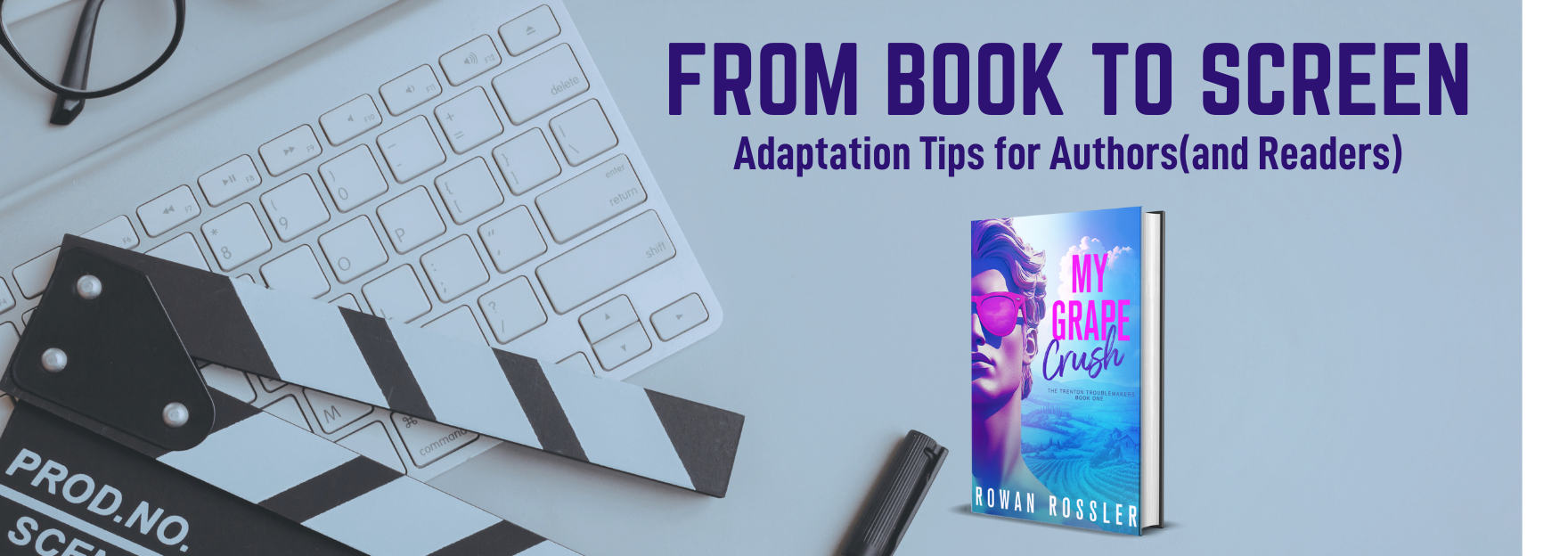
As both an author and TV producer, I’ve lived on both sides of this process. I’ve adapted two previous novels, and My Grape Crush is my third. Along the way, I’ve developed an adaptation template for other authors.
These are the three biggest things I consider before taking a book to the screen.
1. HAVING THE RIGHT BOOK
Not every book works for adaptation. That isn’t a judgement on quality. It’s about whether the book is cinematic and makes sense for the screen.
Novels are internal, while film and TV are external. They require behaviour, choices and conflict that can be seen and/or heard through action or dialogue. Novels that adapt well tend to have:
- A clear, dramatic engine
- Active characters making consequential choices
- Conflict that plays out on the outside
- A contained, visual world.
Books that struggle in adaptation often rely on interior monologue or reflective structures. They require serious reinvention! I’m not saying it can’t be done, but loving your book is not proof that it wants to be on screen. Sometimes, the most generous act is recognizing a story has already found its ideal form.
HINT: The hardest part of adaptation is rarely structural. It’s emotional. It’s about letting go of the novel’s narrative structure and reconstructing it as an expression of the same core idea, shaped by different rules.
But let’s assume your book has adaptation potential. Now what? The next step is understanding the film and TV business. I’m a Canadian author, and this article is being published on a CanLit website, so I’ll focus on navigating our national industry.
2. UNDERSTANDING THE FILM/TV WORLD BEFORE YOU ADAPT
Let me be clear: a screenplay is not a shorter version of your novel.
Creatively, books can wander. Screen stories can’t. My adaptation mindset shifts from interiority and exposition to compression, escalation, visual storytelling, and dialogue that pops. (Thoughts can’t be seen or heard and don’t belong in a screenplay.)
From a business perspective, understanding what the industry wants makes a huge difference to whether a project stalls or moves forward.
HINT: A screenplay is a production document. While reading a script, producers ask: Who is this for? Why now? And can we finance this?
In Canada, that last question determines everything. The Canadian film and TV industry relies on a patchwork of funding initiatives to advance projects. If my idea lies outside of those parameters, I’m fighting an uphill battle from day one.
What makes a project financeable?
My Grape Crush works as a Canadian TV movie for several reasons:
- Canadian content-friendly: writer and story based in Canada
- The Okanagan Valley setting offers maximum financial incentives
- Externalized character conflicts
- Minimal cast, and contained locations
- The romance genre is huge in TV movies
Does your novel need every one of these elements? No, but keep in mind, international locations, a sprawling cast, or period/fantasy stories make financing more complicated.
Scope equals cost.
A great example of the scope/cost relationship is the adaptation of my first novel, The Cruiser. This French Riviera romance stars a famous yacht designer and a high-profile PR fixer he hires to polish his tarnished image.
The scope of the series screams prime-time show with prestigious locations and a marquee cast. Meaning: this show costs more. That’s additional risk. More money and risk mean a longer runway before a project moves into production.
HINT: Understand the scope and format of your adaptation before you start.
Some of the most compelling adaptations succeed because they lean into character, embrace containment, and use limitation as a storytelling tool.
Think about whether one house can replace five. Or can one composite character carry the emotional weight of three? In My Grape Crush, I’m creating a secondary love interest to streamline the narrative and speak to current romance movie trends.
If you adapt with producibility in mind, you signal to the industry that you understand how stories get made.
So, let’s assume I’ve got the right book, and I understand the industry landscape. Now comes the hardest part: deciding what to cut and add.
3. KNOWING WHAT TO CUT AND ADD
This is where authors struggle the most—not because they lack skill, but because of attachment. “Kill your darlings” is easy to say, but much harder to do.
The best adaptations are not necessarily the most faithful. They come from a willingness to cut, compress, and transform. That is the actual work in adapting.
How do I do that?
HINT: My process always starts with research. When I watch adaptations, I ask: Where does the screen version begin? What was cut or combined? What was added and why? How does the TV version show what the book told me?
In Elin Hilderbrand’s romantic thriller A Perfect Couple, the novel opens with a phone call to the Nantucket police chief about a body. The TV series opens with lush visuals of Nantucket at peak summer, then drops us into a swanky wedding before anything goes wrong.
Key differences: The TV show immediately immerses us in a visual world we can feel with instant character dynamics. The murder has yet to happen. The novel’s opening limits us to the Chief’s interiority: processing news that the murder has already happened.
The show also added/altered several key characters to provide richer interpersonal conflict: a long-lost brother, a third son, and a gender-swapped detective. Plus, Greer’s past as an escort was not part of the original novel.
Another strong non-romance example is The Shawshank Redemption. Stephen King’s novella has strong cinematic bones—a confined location, class conflict, and visual anchors like the Rita Hayworth poster.
But the adaptation came alive with the elements that screenwriter Frank Darabont added: scenes that deepened Red and Andy’s friendship, the expanded role of Brooks and his tragic release, the visceral sequence of Andy’s escape. These were barely sketched, or not present at all, in the novella. Darabont understood the screen needed to show hope and friendship transforming men, not just describe it.
THE FINAL TAKEAWAY
TV executives are hunting for unique and relatable hooks.
When you’re evaluating your novel, ask:
- What makes my novel distinctive?
- Are there comparison shows I can use (X meets Y) when pitching?
- Is it budget-friendly?
- Does it travel globally?
Remember, film and TV play out on a much bigger stage than a novel. A successful adaptation must appeal to a wide demographic.
My Grape Crush features a famous influencer who falls hard for the head of marketing at the winery, who hires him to make their rosé go viral.
The story works because it pairs a classic opposites-attract romance duo (a carefree influencer vs. buttoned-up marketer) with a visually seductive small-town wine setting, and a social media hook that feels current and relevant, especially for millennials and Gen Z audiences.
(Those two demographics are catnip for producers.)
In conclusion, adaptation begins with a single question: Can my book speak cinematic language?
If the answer is yes, the next step is facing the industry and financial realities head-on.
Adaptation isn’t the right step for every story, but knowing what it asks of you makes it easier to decide if it’s a path worth exploring.
About the Author
Rowan Rossler is a hopeless romantic on a mission to make the world a better place, one love story at a time. A travel and music junkie, she’s explored every continent except Antarctica and danced like a fool at nearly five hundred concerts. Her romance novels whisk readers to fabulous, sultry locations where boss ladies and maddeningly imperfect men find their happily ever afters. A best-selling author and hopeless romantic with a simple goal: to make the world a brighter place one love story at a time.

 HEA Canada: A CanLit Romance Hub