
Fans of Austen, assemble! This is not a drill! I repeat: This is not a drill! And a warning before we begin, that this guest blog post comes with a lot of deep dive references and quotes and I will not stop. I will totally pause, though (#IYKYK).
Get out your BBC box set DVDs. Prepare yourself for a sopping wet Colin Firth. 2025 is a big deal for Janeites, and you don’t want to be left totally bugging in unpreparedness like the caterers at Mel’s infamous sit-down garden party dinner. Ugh. As if! Get out your Calvin Klein dresses, daddy, and prepare to party like it’s 1999 (or 1799, if you please), because 2025 marks the year of Jane Austen’s 250th and Clueless’ 30th birthdays.
*Hold for applause*
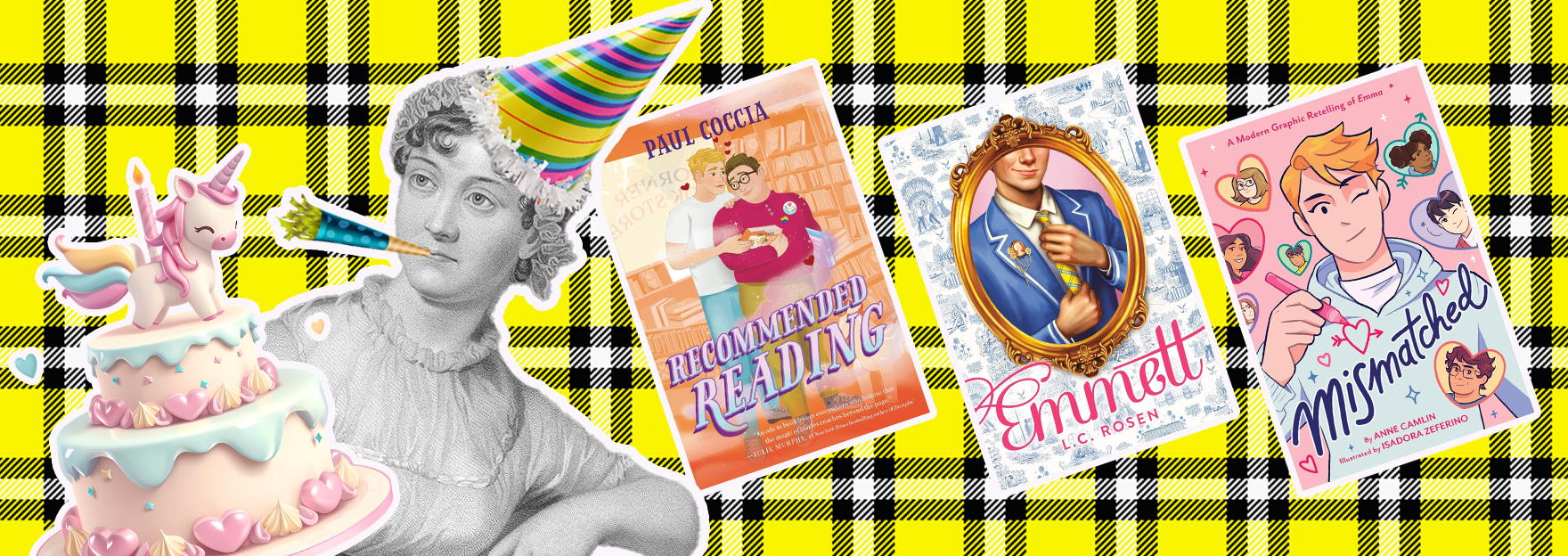
Much like Cher Horowitz explaining the various high school cliques to Tai, I’ve found fans of Austen’s work tend to fall into clear groups. Obviously, there are many Elizabeths and Darcys. And the Elinors and Edwards abound. Rarer are the Persuasions, Mansfield Parks. And, perhaps, the most adamant defenders of their camp, the devotees of Northanger Abbey.
I, however, have always and will always land resolutely amidst the Emmas. I am proudly a disco-dancing, Jane-Austen-reading, Clueless-ticket-holding friend of Miss Woodhouse, to paraphrase Murray, who clocked Christian before Cher and Dionne cottoned on.
And I’m not alone.
When I embarked on writing my queer YA romcom, Recommended Reading, the brainchild of Julie Murphy (yes, that Julie Murphy of Dumplin’ fame, and, yes, we are now squealing like we somehow ended up on the freeway) and her team at Bittersweet Books, I knew who Bobby Ashton was immediately from his character sheet. I could recognize him because Emmas always know one another. Fortunately, Julie and my publisher, Zando, jumped on board with my vision.
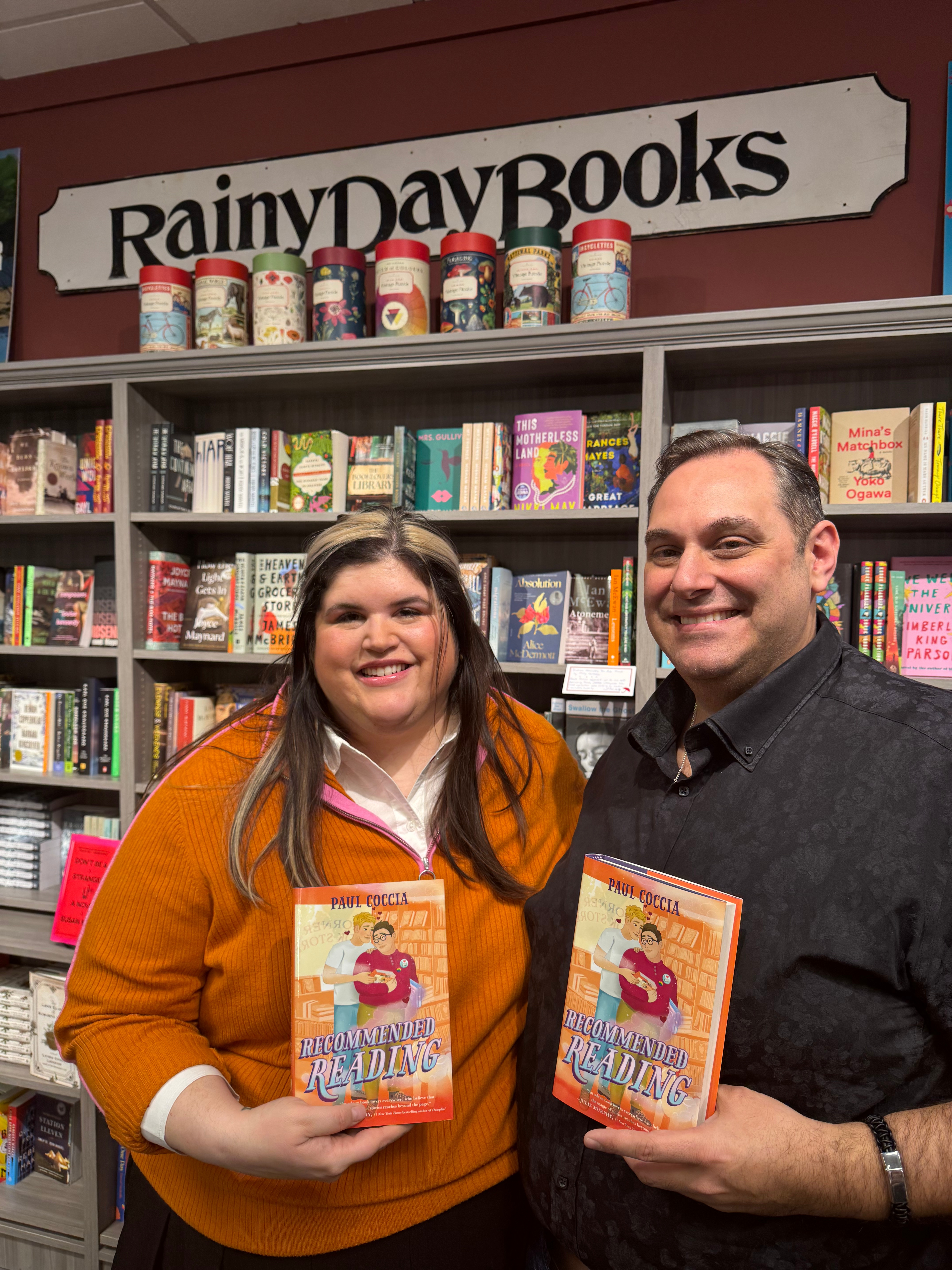
Julie Murphy and Paul Coccia. Photo courtesy of Paul Coccia.
But Austen adaptations abound. Not a surprise as Jane is an OG of romance and, arguably, one of the founding mothers of romantic comedy novels with her novels of manners. And Clueless is often credited by Janeites and scholars as ushering in the modern renaissance of filmic and television adaptations. Some might be surprised, but it’s with delight that we’ve seen how well Jane’s material set in Georgian England adapts to inclusion, representation, and diversity. For example, Bride and Prejudice and fellow Canadian Farah Heron’s The Chai Factor seamlessly weave cultural and racial elements into the classic romance story structures and characters. I don’t think it’s a shock at all since Jane wrote universally acknowledged truths.
So, when I wrote above that I wasn’t alone as an Emma, I was actually being a bit more specific than I initially let on. Since 2023, leading up to the birthdays, there have been three young adult adaptations reimagining Emma as a gay teenage boy: L. C. Rosen’s gender-swapping Emmett; Anne Camlin and illustrator Isadora Zeferino’s graphic novel, Mismatched; and my body-positive Recommended Reading.
Although publishers may have seen three queer Emma retellings as a bad sales omen, rather than creating a Cher and Amber or Emma and Jane Fairfax rivalry, we embraced the rainbow and created distinct variations, demonstrating how Jane Austen is ripe to be played with and evolved in a post-modern way. Consider this my open letter arguing for the formal creation of an Austenverse.
Given how well Clueless took Emma and created a young adult story, the YA spin is an easy leap. But three authors who changed gender and sexuality of the main character is definitely worth some more consideration. After all, titularly Pride and Prejudice is the most obvious low-hanging fruit when it comes to gay reimagings.
So why Emma? Well, maybe a lot of gay males are Emmas for the fact that we all seem “to unite some of the best blessings of existence” and are “faultless in spite of [our] faults.” I write that with my tongue in my cheek, but there’s that Woodhousean confidence often mistaken as a snobbish sense of superiority that many Austen fans who dislike Emma cite as one of the reasons they don’t take to or, outright, dislike the character. Not unaware of the flaws of her creation, Austen wrote, “I am going to take a heroine whom no one but myself will much like.” Since queer people being liked isn’t always a given, it makes sense Emma Woodhouse would speak to 2SLGBTQIA+ authors as she was never designed with delusions of likeability as a necessary or even desirable quality.
Along those lines, L. C. Rosen author of Emmett shared with me, “Many of my queer YAs are about messy, messy boys, and Emma is such a mess… Even Austen said she wrote Emma as a character no one would love but her, and that was what I wanted to do…what I always want to do — take queer stereotypes that have always been presented to me as negative and write them in a way that makes me love them — and maybe readers too. I didn’t care about making Emmett ‘likable’ exactly. I never worry about that. I’m interested in characters who are fascinating, and who I personally love… I am interested in their humanity — what makes them them? Emma, to me, is so obsessed with control. I love that about her. She’s a condescending know-it-all. But if you think about it, this is a woman who lost her mom, her dad’s a hypochondriac, [and] her governess is leaving… That doesn’t excuse her behavior, but it does put it in context. And that context is interesting to explore. I wanted to do that with Emmett, too — he’s a condescending know-it-all control freak, and he has his reasons for it, but that doesn’t excuse his behavior. It just makes him more interesting. And I care about interesting way more than likable.”
Similarly, Anne Camlin didn’t create her Evan from Mismatched as someone who gives the warm fuzzies every step of the way. He makes mistakes and frustrates characters around him.
And my main character, Bobby, has a large dose of I Love Lucy-esque scheming in him that left many readers cringing from the first page. Like any Woodhouse worth their salt, my Bobby is a matchmaker with a remarkable ability to read (not just books, which he does and adores, making the perfect recommendations to help those around him), but people and situations. As long as he’s not directly involved. Unlike his shelf-awareness, his self-awareness has large blind spots. He’s meddlesome, yet benevolent. He has a touch of hubris and thinks he knows better than those around him. He is generous and wants everything to be idyllic, raising the standards along with those around him up to match his freak even if he is driving you up the wall.
I guess, as authors, we all gave a great big, capital-W Whatever to the entire notion of needing to always be liked. That doesn’t mean our characters aren’t able to be identified with or rooted for. After all, Knightleys love not in spite of but because of all an Emmas’ seeming blessings of existence, both good and bad in equal measure. Whether it is Clueless’ Cher Horowitz, Mismatched’s Evan, Emmett’s Emmett, or Recommended Reading’s Bobby, an Emma is accomplished. Always. Skilled? Naturally. Testing of patience? Perhaps on occasion. Miss Congeniality? Not really.
With an entire year to celebrate Jane and Clueless, in addition to rereading and rewatching your favourite Austen, why not fall in love with a new spin on the classic takes? Even if you don’t change allegiances and join us Emmas, we will add chairs and haul ass to the kitchen to redistribute the food ensuring we can all party together, because may I remind you, it does not say RSVP on the spine of any Austen novel.
Self-proclaimed Author of Glitterature, Paul Coccia writes books primarily for kids and teens such as Recommended Reading, Cub, and On The Line, coauthored with Eric Walters. His books have been nominated for several awards (and even won some), and has has been fortunate enough to have his books included on a variety of lists. He has a specialist in English Literature and a Masters of Fine Arts in Creative Writing from the University of British Columbia.
 HEA Canada: A CanLit Romance Hub